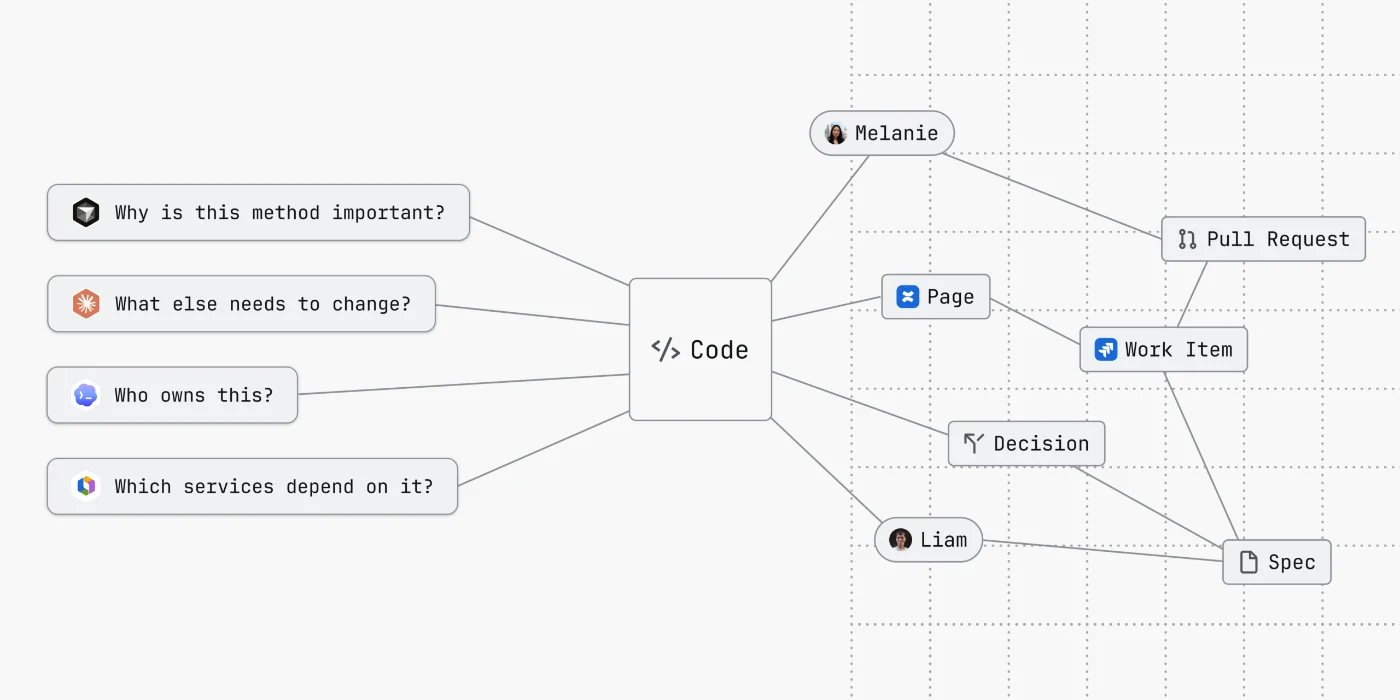
Everyone agrees code is cheap now.
Three documents on how to run software delivery with AI landed between August and October 2026. Atlassian's "AI SDLC transformation playbook". Anthropic's "AI-native SDLC playbook". Google's DORA research. They open with the same sentence - code is no longer the bottleneck - and then send you three different places. This note is the comparison, with the vendor logos left on.
Seven pillars, two vendors.
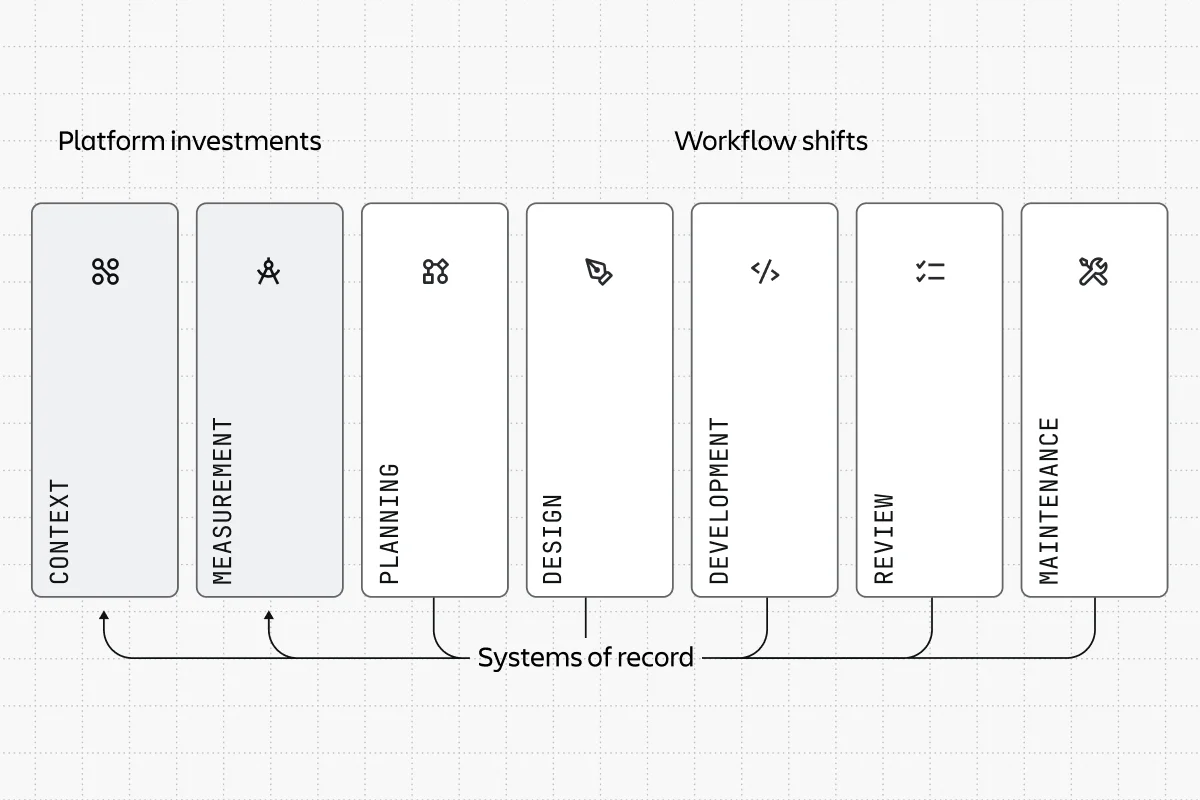
Atlassian's version, by Matthew Canham, Senior Group PM for AI. Two platform investments you make once - a context graph and a measurement loop - and five workflow shifts you make one at a time: planning, design, development, review, maintenance. Everything writes back to a system of record, which in this diagram is Jira and Confluence.
The honest part is the ordering. Buying agents, licences and IDEs first gets you incremental gains - their words - because an agent without context starts in the wrong place and an org without measurement cannot tell gains from hype.
It is also, structurally, Anthropic's August playbook with the repository swapped for the graph. More on that in two slides.
Five shifts, one line each.
| Planning | Specs written from the codebase, not from memory. PMs refine and decide instead of drafting from blank. | agents in Jira |
|---|---|---|
| Design | Design standards live next to the code. Designers and PMs ship prototypes and small UI fixes themselves. | graph + IDE |
| Development | Coding agents (Cursor, Claude Code, named) get org context over MCP. Decisions go back to the ticket. | Teamwork Graph CLI |
| Review | AI handles the routine findings first. Humans keep the judgment call on what is left. | AI Reviewer |
| Maintenance | Agent loops triage incidents and clear routine work, escalate when stuck, log everything. | agent loops in Jira |
Each shift comes with a "friction, shift, Atlassian approach" triplet. The friction column is good - it is the list of things your team already complains about. The approach column is a product catalogue. Read the first two columns, then decide whether the third applies to you.
Same title, different unit.
| Atlassian · Oct 2026 | Anthropic · Aug 2026 | DORA · 2025, ~5,000 respondents | |
| Unit of change | The organisation: graph, metrics, rituals, roles | The repository: intent.md → spec.md → plan.md → REVIEW.md | The team: seven capabilities, AI as an amplifier |
| Where truth lives | Teamwork Graph, Jira, Confluence | Git history. Each stage commits an artifact the next one reads | Wherever it already lived. DORA does not care |
| Human gates | "Preserve accountability" - unspecified | Named: intent, spec, plan, PR, release. Agent cannot approve its own code | Clear AI policy, platform quality |
| Evidence | Internal benchmarks, two CTO quotes | None. Numbers are illustrative and it says so | Survey. Throughput up, instability still rising |
| Sells | Teamwork Graph, agent loops in Jira | Claude Code, Claude Security | Nothing directly. Google Cloud hosts it |
Anthropic: "The AI-native SDLC playbook", L. Claxton, 21.08.2026. DORA: "State of AI-assisted Software Development", Google, 09.2025. Drafted with Claude, which is Anthropic's product, and reviewed by a human on our team before publishing. We think the table is still fair. You decide.
Whose benchmark?
- Atlassian says
- 44%
- more accurate results and 48% fewer tokens when agents have graph access. Issue cycle time from 11.5 to 6.7 days. Source: "internal benchmarks". No method, no n.
- DORA says
- ~90%
- of professionals use AI daily, more than 80% feel more productive - and delivery instability keeps rising. Speed went up. The systems around it did not catch up.
- METR says
- -19%
- July 2025 RCT: experienced developers were slower with AI while believing they were 20% faster. The Feb 2026 follow-up found 4-18% faster, with weak data, because developers refused to work without AI any more.
Three numbers, three methods, three answers. The only one that measured your situation is the one you run yourself. Which is, to be fair, exactly what Atlassian's second pillar says - they use DX, with Jira, Cursor and Claude Code as inputs. Pillar two is the one to copy even if you buy nothing else.
Where all three agree.
- 01 · Context before agents
- An agent that cannot see the ticket, the decision and the owner starts in the wrong place. Graph, repo or wiki - pick one and make it readable.
- 02 · Measure before scaling
- Set up the feedback loop while adoption is small and the baseline still exists. Nobody measures the baseline afterwards.
- 03 · Humans at the gates
- Spec sign-off, plan approval, PR approval, release. The agent proposes, a named person accepts. Name the person.
- 04 · One workflow first
- Pick the stage with the most pain, go deep, then widen. Both playbooks say "start with a single play". DORA says the same in survey form.
Four points, two vendors and a research programme. When a sales deck and a survey agree, that is the part worth doing.
Where they don't.
The real disagreement is where the truth lives. Atlassian: in the graph, because the ticket, the page and the decision are already there and the code is one node among many. Anthropic: in the repo, because git already has history, review and permissions, and a markdown file costs nothing. DORA: wherever your team can keep it accurate.
If your org runs on Jira and Confluence, the graph argument is honest. If it runs on GitHub and a Slack channel, the repo argument is. The dangerous answer is both: a spec in Confluence and an intent.md in the repo that disagree by Thursday.
Pick the one your developers will actually keep updated. That is usually the one they already open every morning.
For a 20-person Jira shop.
Neither playbook was written for you. Both assume a platform team. Here is the version that fits a company where the platform team is one person and a Confluence space.
- Week 1 · Context
- One Confluence page per service: owner, what it does, what depends on it, where the standards are. Short enough that an agent reads it in one call. That is your graph.
- Week 2 · Measurement
- Cycle time, change failure rate and "rework after merge" from Jira and your git host. Write the numbers down before anyone installs anything. That is your DX.
- Week 3 · One stage
- Review is the cheapest win: let AI take the first pass on pull requests, keep the human approval, and compare the two numbers above in a month.
If you would rather someone did weeks one to three with you, that is a Tuesday for us. Contact: hello@techodesk.ee
Sources: M. Canham, "The AI SDLC transformation playbook", atlassian.com/blog, 01.10.2026 · L. Claxton, "The AI-native SDLC playbook", claude.com, 21.08.2026 · DORA, "State of AI-assisted Software Development", 2025 · METR, arXiv:2507.09089, and its Feb 2026 follow-up · Figures © Atlassian, used for commentary. SpotOn and Outreach are Atlassian's customers, not ours.