Techodesk.Field notes
1 / 13you
Note 02 · 07.10.2026 · Atlassian · Ivar Kaljusaar

Your new teammate has no pulse.

Atlassian announced AMP, the Agentic Multiplayer Protocol, at Team '26 Europe on 7 October 2026 - and gave AI agents a seat at the table. Here is what that seat actually comes with, what shipped, and what you should set up before Monday.

You are not alone in this deck. Check the corner around slide 4.

§ 01

It's called a protocol. It isn't one.

MCPModel Context Protocol. A spec, SDKs, a conformance story. Atlassian's server speaks it.protocol
A2AAgent-to-Agent. A spec under the Linux Foundation. Agents discover and talk to each other.protocol
AMPAgentic Multiplayer Protocol. A keynote, two blog posts and a press release.a label

That is not a complaint. AMP is Atlassian's name for the house rules of letting agents into the room: who they are, what they may touch, what they know, and how you check their work. Rules are useful. Just don't go looking for the RFC.

Atlassian's own definition, from Jamil Valliani, Head of Product for AI: AMP "defines how agents take part in multiplayer work with an identity, scoped authority, shared context and tasks, and results you can review" - and it is "live across the Atlassian platform today". Live, in the sense that the rules apply. Not in the sense that you can download them.

As of 08.10.2026 there is no spec, SDK or developer programme called AMP on developer.atlassian.com. If that changes, this slide gets a footnote.

§ 02

Four rules, one acronym.

01 · Identity
Every agent is a named account with an owner and a profile. No more "automation for Jira" doing everything as the admin who left.
02 · Scoped authority
The agent gets the permissions of someone, not of everyone. Which someone is your decision, not Atlassian's.
03 · Shared context
It reads the same tickets, pages and decisions the team does, through the Teamwork Graph. Nothing is pasted into a chat window.
04 · Reviewable results
Output lands where work lives - a comment, a page, a pull request - with the agent's name on it and a human's approval still required.

If this reads like your onboarding checklist for a human contractor, that is the point. Atlassian said the same thing in slightly more words.

§ 03

Agents get a face.

Viewing this page Ivar Kaljusaar Maret Tamm release-notes-agent agent · owner: Maret
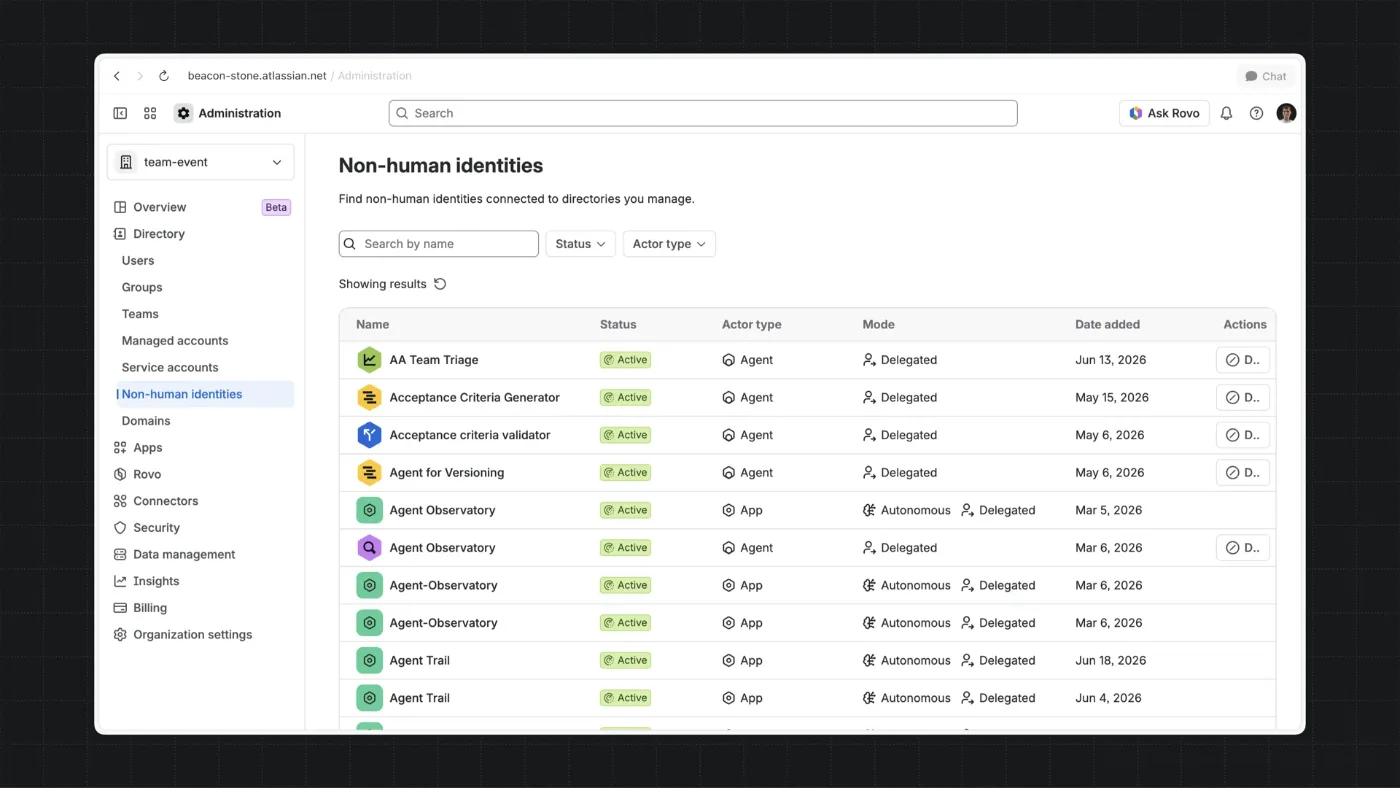
Atlassian admin, Non-human identities page (beta): a list of agents and apps with status, actor type, mode Delegated or Autonomous, and date added
Admin · Non-human identities, beta. Note the Mode column. Screenshot: Atlassian.

Agents, apps and service accounts get an inventory, an owner, a profile, and a presence dot next to the humans. Atlassian's launch post says the agent accounts and the inventory are coming soon - the screenshot says beta. Either way, the intern who never goes home will show up in "who's viewing".

Agent Sessions does the same for coding agents on a developer's laptop: the run is pinned to the Jira issue, so the board shows what the robot is doing, not just what the human claims.

Look at the corner. You have company.

§ 04

@mention a robot.

Agents live in the comment thread, not in a side panel. You @mention one the way you @mention a colleague, it does the work, and it replies in the same thread under its own name. Loom briefs, Figma and your IDE plug in through the MCP server.

Atlassian's phrase for the pattern is create → review → act. The agent creates, a human reviews, then it acts. The review step is not optional and it is not hidden.

Same thread, same identity, same audit log. A chat window never gave you that.

Maret Tamm@release-notes-agent the last 14 comments on this epic - what is still blocking 4.2?
release-notes-agent agent · owner: MaretThree blockers. One is a licence question assigned to you since 23.09. Draft release note is in Confluence, status "awaiting review". I have not changed any fix versions.
Maret TammAh. Yes. That one.
§ 05

Who is it pretending to be?

The one decision that determines whether your audit log is useful or theatre. AMP offers two modes.

Run as user
The agent inherits the permissions of whoever triggered it. Simple, and it can never see more than the human could. But the audit log says Maret changed the fix version, when a robot did it on her behalf. Fine for drafting. Awkward for anything that moves money or data.
Service account
The agent has its own identity and its own, deliberately small, set of project roles. The log says the agent did it, the owner is on record, and you can revoke one account without touching a person. More setup. The only honest option for anything that runs unattended.

That is the Mode column on the admin screenshot two slides back: Delegated is run-as-user, Autonomous is a service account. Corner again, by the way. The agent is now running as you.

§ 06

The graph remembers everything.

250Bconnections in the teamwork graph

A new hire takes six months to learn who to ask and which closed ticket already answered the question. An agent gets the same context on its first prompt - tickets, pages, decisions, code, now indexed down to functions and classes.

80+ connectors feed it. New this week: Zoom, Gong, Microsoft Entra ID, Google Identity. Your meetings and your identity provider are now context too.

Good news
Grounded answers. Less prompt-stuffing. The agent knows the 2023 decision before you remind it.
Less good news
Every comment anyone ever wrote in a closed ticket is now training material for a colleague who never forgets.

Including that comment from 2019. You know the one.

§ 07

Brussels gets a slide.

EU-only inference
LLM processing can be restricted to EU-hosted models. Ask which models, whether it covers Rovo Chat and MCP tool calls, and what happens when the EU model lacks a feature.
EU AI Act · ISO 42001
Atlassian is positioning the whole stack as compliance-ready. Useful words for your DPO. Still your obligation to document the use case.
Guard Premium
Real-time scanning of content and attachments for sensitive data, with guardrails on what agents may read. Premium tier. If you do not have it, decide on purpose rather than by default.

Audit logging covers agent actions the same as human ones. Observability is there. Whether anyone reads it is, as ever, a staffing question.

The compliance material was in the keynote, not the appendix. For a European customer that is the most interesting thing Atlassian said all week.

§ 08

220 tools and a diet.

Tools in the MCP server
220+
Jira, Confluence pages, databases and whiteboards, Bitbucket pull requests, Code Search, Loom transcripts, Goals. JSM coming.
Fewer tokens per task
25%
Atlassian's own benchmark on Claude. More surface, less context bloat. Your Rovo credits will notice.
Tool calls per day
15M
Fifteen times what it was in April. About two million people a month are already using it.

This is the part of the announcement that shipped with documentation. Forge developers can publish custom MCP tools, Marketplace apps can expose their own Rovo agents, and all of it rides the same identity and permission model as everything else on this deck.

Numbers are Atlassian's, from the Team '26 Europe MCP blog and press release. Treat "15x" the way you treat any number in a keynote.

§ 09

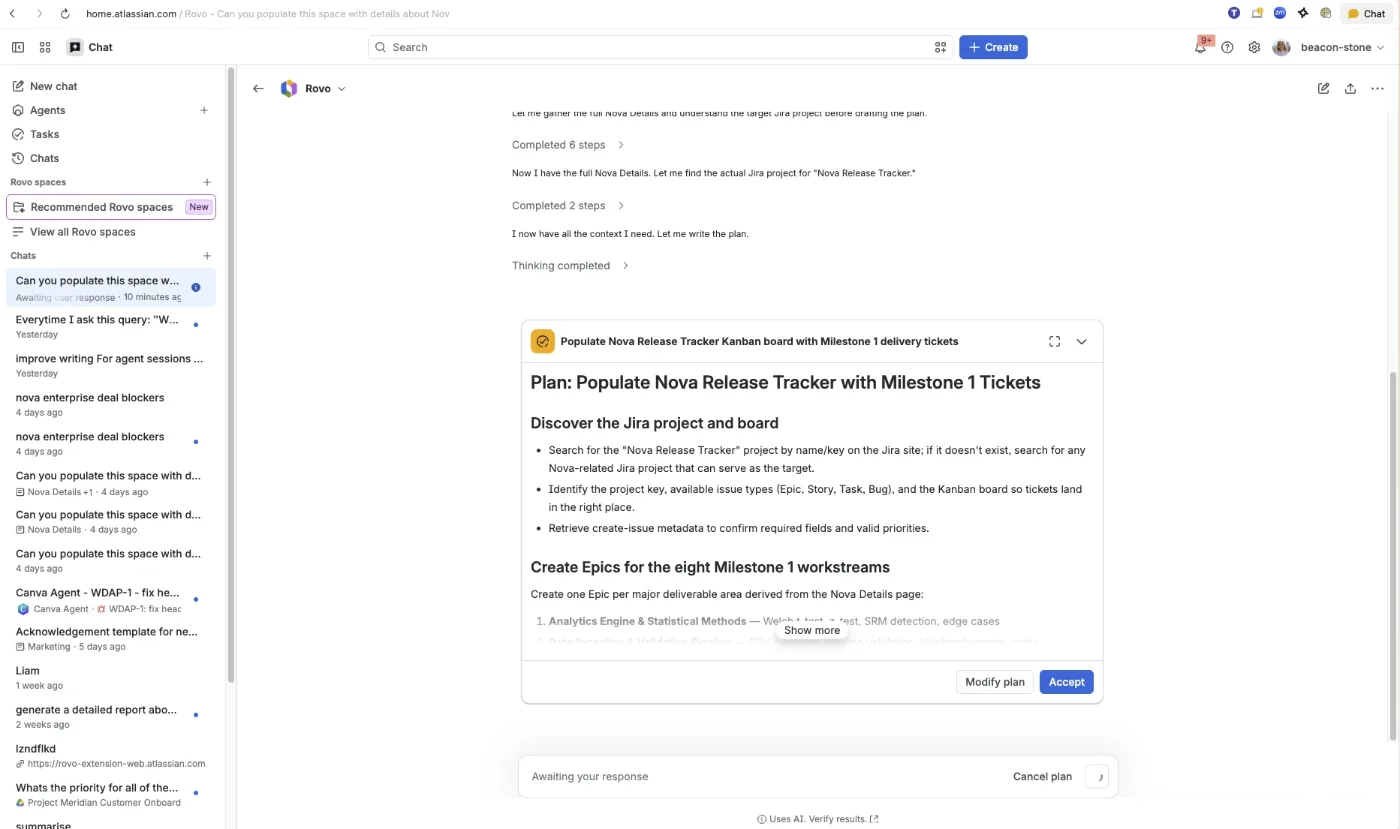
It writes a plan. You press Accept.

Rovo Work in Rovo Chat: a multi-step plan to populate a Jira release tracker with milestone tickets, waiting on Modify plan or Accept
Rovo Work. Plan drafted, nothing created yet. Screenshot: Atlassian.

Rovo Work is a new mode in Rovo Chat for jobs that take more than one prompt: it drafts a plan, waits for you, then runs for hours in a sandbox the admin governs, across Jira, Confluence and connected tools. The Accept button is the whole AMP story in one pixel.

Alongside it, an Artifacts app: AI-generated plans, models and HTML views get a permanent URL, embed in Confluence, Jira or Slack under normal permissions, and get indexed back into the graph. The robot's homework becomes a page the next robot can read.

Availability for both: "announced". No date on the post. Ask before you plan a rollout around it.

§ 10

The graph learned to read code.

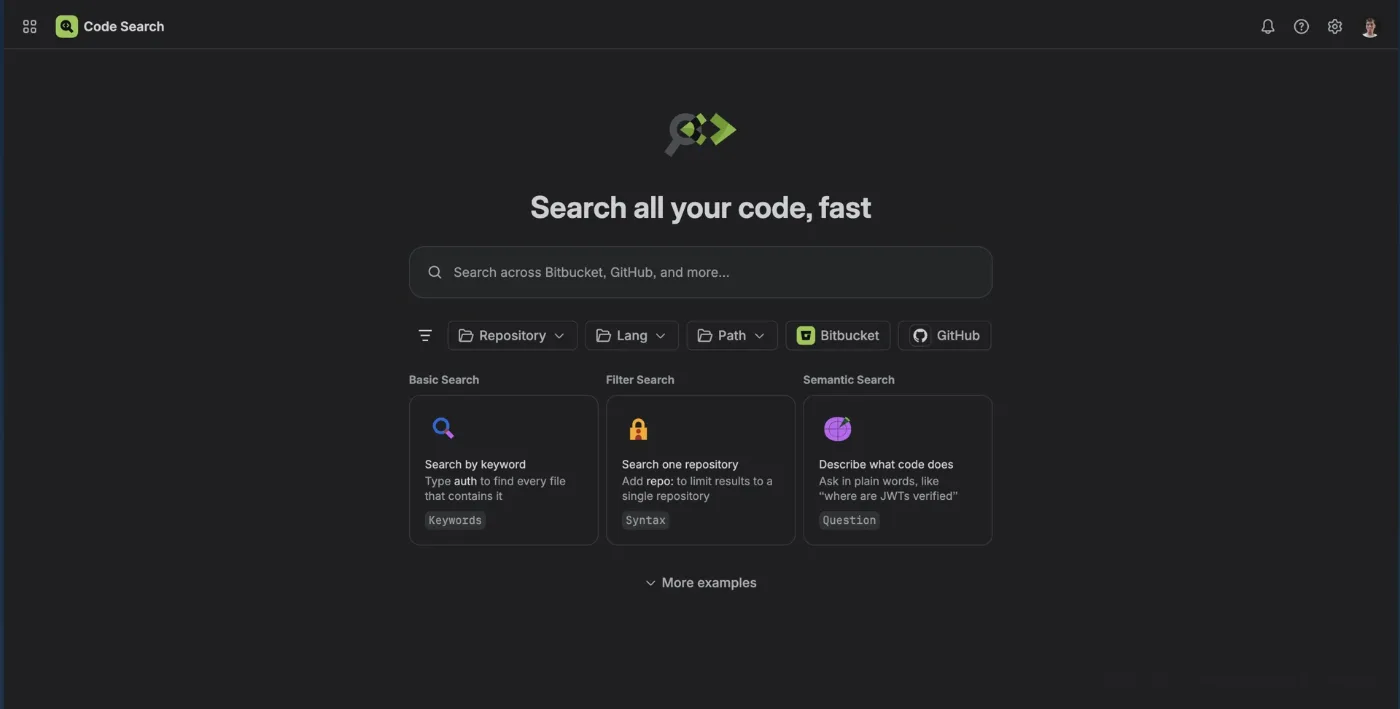
Rovo Code Search: search across Bitbucket and GitHub by keyword, repository or plain-language question
Rovo Code Search. Bitbucket and GitHub, no clone. Screenshot: Atlassian.

Two new context types for the Teamwork Graph. Rovo Code Search indexes functions, classes and symbols across Bitbucket and GitHub without cloning anything, so an agent can answer "where are JWTs verified" from inside a Jira comment. Atlassian Insights does the same for structured data: 20+ sources with a catalog, glossary and lineage.

Focus gets agentic updates - cross-project progress summarised for whoever owns the portfolio. Ten million human-agent collaborations a month, says the post. That is the number to remember when someone asks whether this is real yet.

Code Search reads your repos. Decide who that includes before the connector does.

§ 11

Monday morning checklist.

Six things a Jira admin should do before any agent gets an account. Tick what you have already done. The deck is keeping count.

0 of 6 done. The agent in the corner has noticed.

§ 12

Tell us what's broken.

release-notes-agent has reviewed this deck. You ticked 0 of 6 boxes. It has opened 6 tickets and assigned them to you. Running as you, naturally.

If agents are about to get accounts in your Jira and you would like the identity and permission model sorted before they do - that is a Tuesday for us. Contact: hello@techodesk.ee

Sources: J. Valliani, "The Atlassian platform is for multiplayer human-agent work", atlassian.com/blog, 06.10.2026 · Team '26 Europe keynote, MCP blog and press release, 06-07.10.2026 · Screenshots © Atlassian, used for commentary · developer.atlassian.com (checked for an AMP spec; none yet). Maret Tamm and release-notes-agent do not exist. The permission question does.

↓ next · ↑ back